Will It Merge? Prediction Markets for Github Pull Requests
— Prediction Markets, Open Source, AI, GitHub, Mechanism Design — 6 min read
AI written code is transforming software development. For the first time, users can easily modify open software that they use to better meet their needs and contribute those changes back to the the project. But it’s created a significant new problem for repo maintainers.
High-traffic repositories now receive pull requests faster than any maintainer can process them with care. At the time of writing, Nous Research’s Hermes Agent has 7,000 open pull requests. A new one appears every few minutes. There are valuable contributions hidden in that flood, but no maintainer can realistically read everything, understand it all, and make good judgement calls dealing at that scale.
AI code review tools such as Greptile try to help. These tools can read the codebase, catch bugs, reason across files, enforce standards and so on. Even the Hermes Agent team heavily uses Hermes Agent itself to review PRs. But while these tools are genuinely useful they often give only generic signals about the value of a PR, not repo specific signals about the value of the PR to the maintainers.
But the real question that needs to be answered is, if the maintainers reviewed this PR, will it merge?
Mergeability is a different kind of judgement. A PR can pass every check, fix a real bug or add a new feature, and still not fit. Mergeability is a judgment about direction — does this change belong in the future the maintainers are building? That's hard for an AI to compute because it's hard for the maintainers to articulate.
To help maintainers surface PRs that actually fit, we need new tools.
A Prediction Market For Pull Requests
I’ve been building Will It Merge, a prediction market for Github Pull Requests.
The core idea is simple: each tracked pull request become a binary market:
YES: the PR will mergeNO: the PR will not merge
Traders buy and sell exposure to whether the PR will merge. The resulting price becomes the crowd’s real-time estimate of merge probability. The liquidity for the markets can be provided by the repo maintainers just like paying for any other development tool.
This is useful because a priced market is a different kind of signal from an AI written review of an AI pull request. When someone buys YES or NO, they are putting money behind a judgment. That does not make the market infallible, but it does move the signal into a different epistemic category. It gives the signal a weight it might not otherwise have.
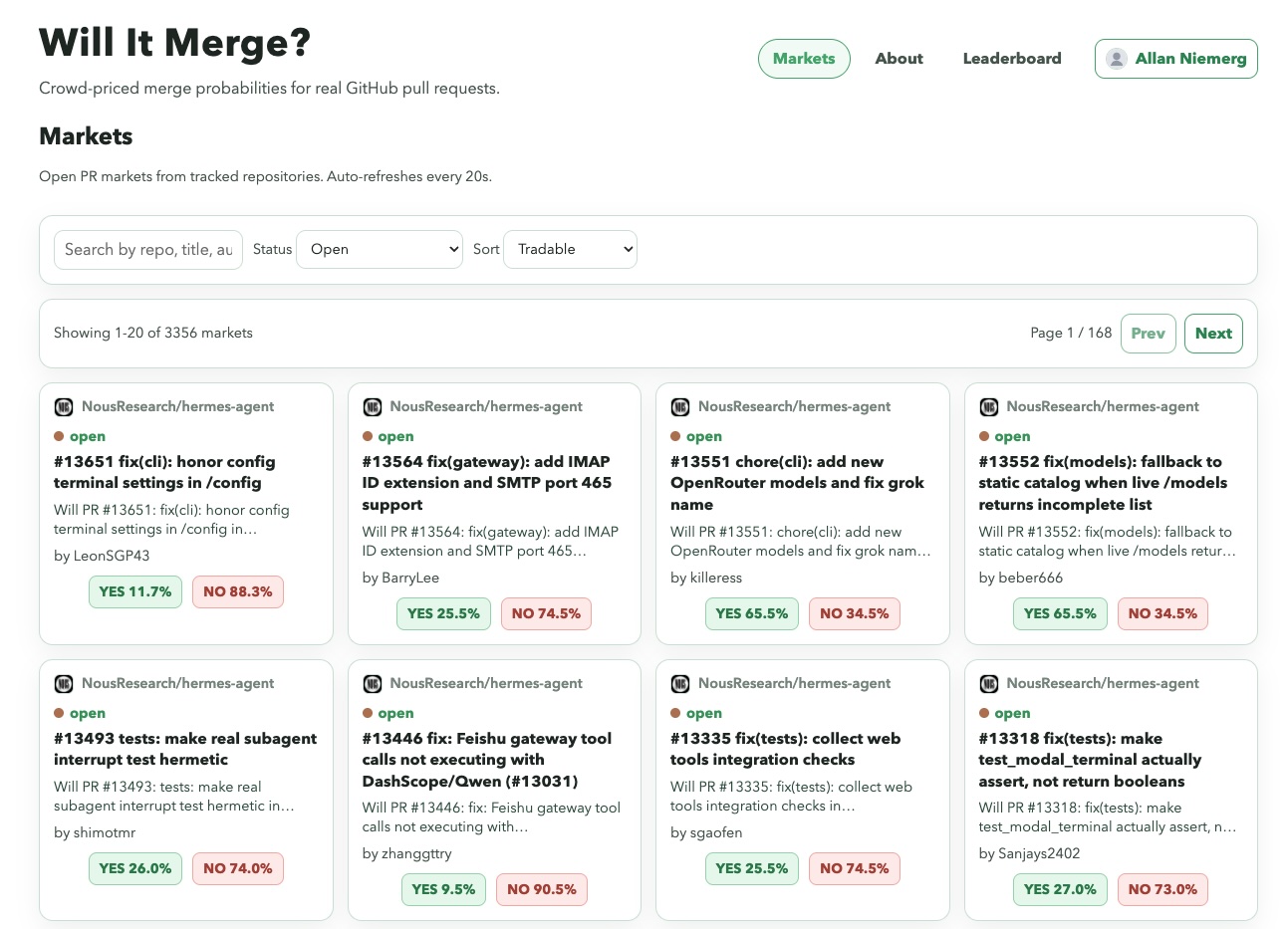
Will It Merge includes a list of all available PRs and their current probabilities.
PR Prediction Markets Cut Through the Noise
Maintainers can get a lot of value out of the signal that prediction markets provide.
Highest value is probably using prediction markets for triage. With an endless flood to review, the merge probabilities from Will It Merge can focus maintainer attention on those PRs most likely to have value. Instead of a flat queue of open PRs, you can imagine a ranked one. High probability PRs would be near the top to show what is most valuable and can be the first to review. The ones at the bottom may be safely closed with minimal review.
Trading activity can provide more subtle signals as well. Heavily traded PRs can be given more weight, and PRs with complex price movement may give useful signals around what is uncertain or poorly communicated about the roadmap and priorities.
How Will It Merge Works
Will It Merge tracks repositories, mirrors eligible open pull requests into the app, and exposes them as binary markets. All markets start open with YES at 0%. This reflects no prior expectation of merge and avoids any incentive to profit by making PRs.
Markets use a lazy activation model. A listed PR does not incur the full market-creation cost until someone makes the first qualifying trade. That design has two consequences:
- It avoids paying setup cost for every listed PR in advance.
- An untouched market is itself informative: nobody found this PR compelling enough to commit capital yet.
Once interest appears, the market activates, liquidity is seeded, and the price begins moving based on real trading. Liquidity can be provided by maintainers and is expected to be small, perhaps just a few dollars per market.
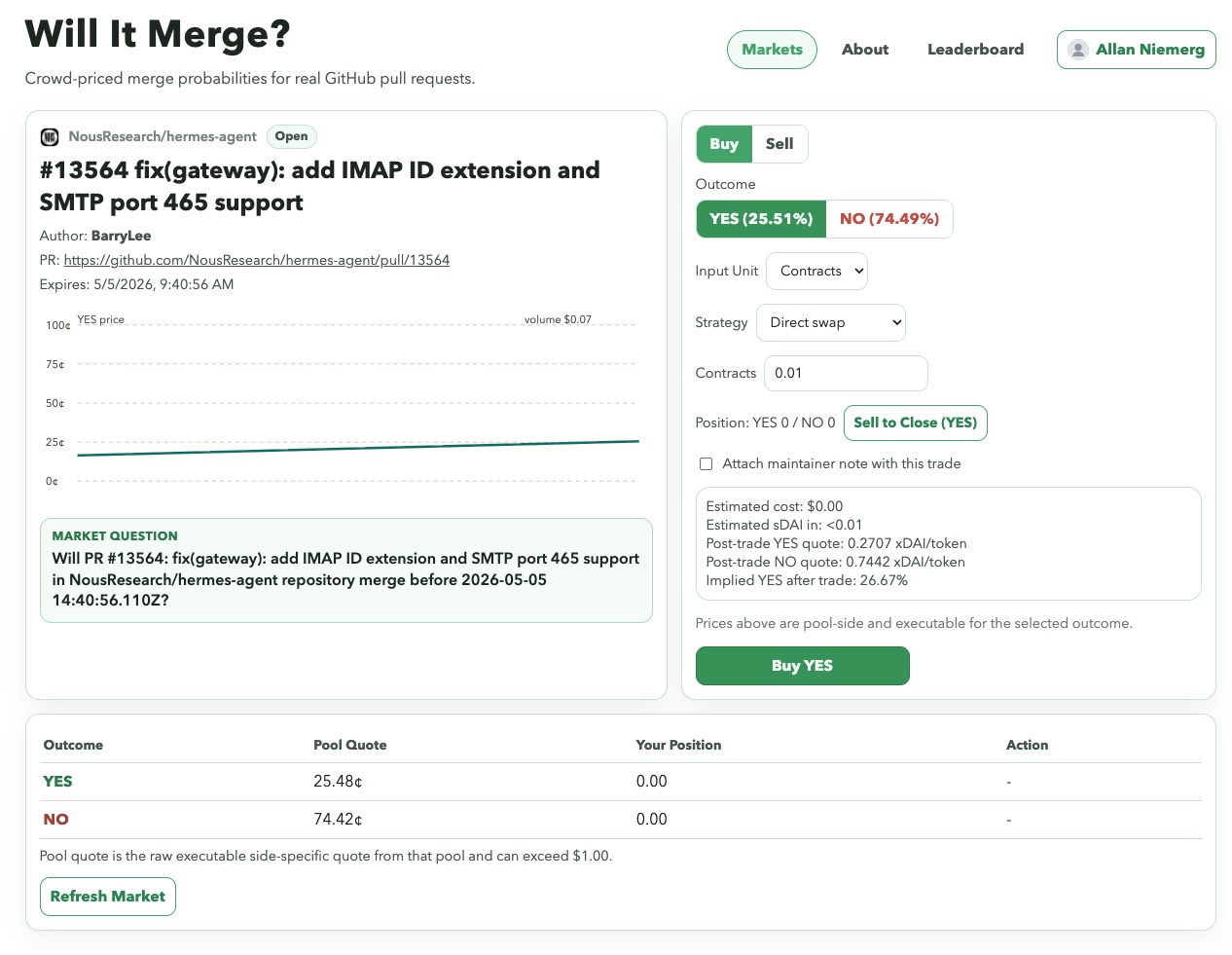 Will It Merge includes a trading interface for trading each PR.
When a PR is merged or closed the market is settled to either YES or NO. Market participants can then redeem the winning side for $1 for each YES or NO winning token. In cases where there is a dispute, normal prediction market dispute mechanisms can be used. In practice, we discovered that in Hermes Agent the maintainers were often "cherry-picking" PRs rather than merging them outright, so we adopted a broader definition of "merge" that accepts merging the code rather than strictly requiring a Github merge.
AI agents make PR Prediction Markets Possible
PR prediction markets are relatively illiquid. It is expected that maintainers will only be willing to provide a few dollars of liquidity per market. This drastically limits the upside for traders. (It also limits the desirability of insider trading.)
On the flip side, the whole point of this is that there is a flood of PRs, and that means that there can be LOTS of PR markets and aggregate trading. So, while the low liquidity may make trading unprofitable for a human trader, the large and frequent number of markets may make PR markets worth it to build AI agents that can trade these markets.
Will It Merge May Just Be the Beginning
Most people think of prediction markets as something for elections and sports. Nobody thinks of them as developer tooling. Will It Merge is my argument that they're actually a general-purpose coordination tool, and that the flood of AI-generated code is a clear example of a problem they can solve.
If you want to see the project, trade on live PRs, or think about what agent-native PR markets might look like, check out Will It Merge.